
Thoughts From A Psychotherapist

This is a collection of all of my Blog Posts.
July 2026

Living with Rejection Sensitivity Dysphoria

2026-07-28T18:05:58-04:00July 27th, 2026|ADHD, autism, Neurodivergence, Thoughts From A Psychotherapist|

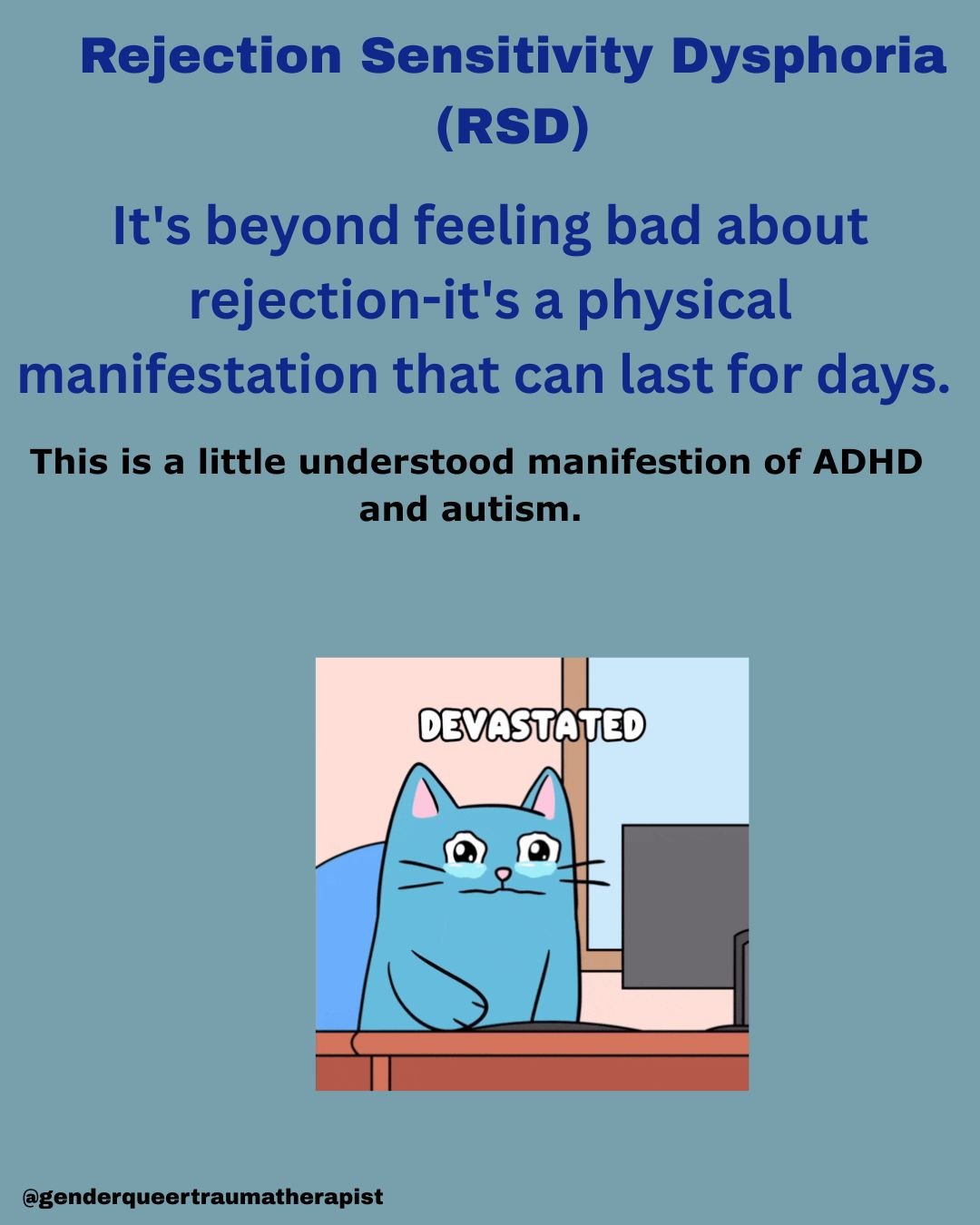
Part of ADHD for many of us is rejection sensitivity dysphoria. Many people minimize the experience, but recent research has highlighted the link between RSD and physical sensations. They varied from person to person, but all participants experienced this physical manifestation (Rowney-Smith et al., 2026). I myself have experienced this. For me, RSD is the worst part of ADHD. I recently had an episode that lasted a week. A week of being in a shame spiral that I could not get myself out of.

The research also discussed how people coped with RSD, and many use withdrawal as a technique. If you avoid situations where you could be potentially rejected, then you won’t be rejected, correct? I often have parts that want to avoid certain social situations because of this fear. If it gets triggered, I know I will suffer for days. The participants also discussed how the expectation of rejection is often as bad as, or worse than, actually being rejected (Rowney-Smith et al., 2026).

When it happens, participants reported masking it because they are often perceived or told they are oversensitive, and they want to avoid that (Rowney-Smith et al., 2026).

Dr. Megan Anna Neff describes rejection sensitivity as a “normative human experience) but dysphoria as  “an extreme and often distressing emotional response to perceived rejection or criticism, which goes beyond the typical range of reactions. This pain can significantly disrupt a person’s capacity to engage in relationships, work, and various aspects of life” (Neff, October 4, 2023, para 20).

It is so important not to invalidate the experience of someone with RSD by minimizing the experience because that just perpetuates neurodivergent stereotypes and beliefs about being too much or not fitting in. I have a friend that we can call out and name RSD when we see it in each other, and that, to me, is helpful. Support around the shame and related feelings also works well for me. In the research, people reported that reassurance was also helpful to them, though they did not usually ask for it, because….. RSD (Rowney-Smith et al, 2026).

RSD is just beginning to be researched. It has long been part of a female ADHD profile, but since that is something that is just being studied and acknowledged, little is known right now. It also often shows up in autistic women. And men can also experience it.
This is one of the places I recommend for consultation and resources from people with lived experience. Dr. Megan Anna Neff has many resources on her Neurodivergent Insights Blog. Since people with RSD do not experience these challenging emotions, it can be hard for them to understand them. Often, they just feel the person is overreacting. If you want to be supportive, reassure and name the pain without invalidating it.

References

Neff, D. M. A. (2023, October 4). The pain of Rejection Sensitive Dysphoria (RSD) [Blog]. Https://Neurodivergentinsights.Com/. https://neurodivergentinsights.com/rejection-sensitive-dysphoria/

Rowney-Smith A, Sutton B, Quadt L, Eccles JA. The lived experience of rejection sensitivity in ADHD – A qualitative exploration. PLoS One. 2026 Jan 21;21(1):e0314669. doi: 10.1371/journal.pone.0314669. Erratum in: PLoS One. 2026 Mar 13;21(3):e0345112. doi: 10.1371/journal.pone.0345112. PMID: 41564005; PMCID: PMC12822938.
March 2026

Many Therapists ARE NOT culturally competent to work with Trans and Gender Diverse Clients

2026-03-24T16:08:23-04:00March 24th, 2026|Advocacy, Gender identity, Thoughts From A Psychotherapist|

Today I was in a therapist group of over 30k therapists when someone posted an article promoting Kenneth Zucker’s work as being a different way to “Treat gender dysphoria”. The person stated that they had never heard of a way to “treat” gender dysphoria in kids other than affirmation/reinforcement of the dysphoria.

I give credit to the many therapists who called it out. However, the admin said, well, it’s an article, and I don’t necessarily condone it. Yeah, you allowed it-it harms trans people, take some responsibility. Then, when I said she was not culturally competent to work with trans-gender-diverse clients, she accused me of attacking her. Others questioned me, saying it was not a safe space. That being in a space where only one side is heard is not to anyone’s benefit.

No professional organization says this work is unethical. NONE. It is against our Code of Ethics to conduct conversion therapy. Period! And the people saying things like “all sides need to be heard,” even if they do not agree with the post, are full of you-know-what! You don’t get to both sides of this issue. There is actually clear right and wrong.

I am exhausted by therapists being so ignorant. I recently was looking for a new therapist, and it’s a  horror to find ones that are gender affirming at the most basic level. One therapist told me she believes in live and let live and that she could help people who had figured their gender identity out, but not on the journey. What in the ever-loving F does that even mean?

They act like minors are getting surgeries. They are not. They act like affirmation means therapists are telling clients what to do and how to do it. I was taught to be where the client is, and that is how I work. One therapist actually commented, “When did therapists become affirming?” UMMMMM

Please, for the sake of people’s lives, do not work with trans people if this is your viewpoint. Refer out. I have seen the damage done by bad therapists to people.

And read your code of ethics!!


February 2026

Aphantasia: Can you picture the apple?

2026-02-03T13:03:04-05:00February 3rd, 2026|Thoughts From A Psychotherapist|

Aphantasia: Can you picture the apple?

Close your eyes and imagine a red apple.

Did you see it? The shine on the skin? The curve of its shape?

For some people, that question is confusing—not because the apple is hard to imagine, but because there is no image at all. No picture, no movie, no faint outline. Just knowing what an apple is.

This experience is called aphantasia, and it’s far more common—and far more misunderstood—than many people realize.

I am a person with aphantasia. I did not even realize this had a name. I just knew I couldn’t visualize.


What Is Aphantasia?

I went to find a neuro-affirming definition and found Aphantasia Network. I highly recommend their website if you want to learn more.

Their definition is “Aphantasia is the inability to voluntarily visualize mental images — a neurological variation that affects how people think, dream, remember, and learn. When someone with aphantasia tries to visualize an apple, a loved one’s face, or a childhood memory, they experience no mental pictures.”

Now, some of us get some variations on that. I can’t visualize, but I can access something-for me, I feel like I visualize visualizing. But I am sorely lacking in certain things. Like if my spouse asks if I think something would look good on a certain wall, I say “I Dunno! “ Because I need to see it actually there to know.

This is one of those things that, for many, goes unnoticed for years. That is because none of us knows how another brain works.

How Common Is Aphantasia?

Aphantasia Network reports it affects between 1-4% of people. But again, since it is often missed, it may be more common than that. It is linked to other neurodivergences, including Autism, ADHD, Dyslexia, and Prosopagnosia (face blindness)

Aphantasia in Therapy Settings

Many therapeutic approaches assume the presence of mental imagery:

  • “Picture your safe place”
  • “Visualize your inner child”
  • “Imagine the memory like a movie”

For clients with aphantasia, these instructions can feel frustrating, alienating, or quietly shame-inducing. Others like me mask it and just find a way around it. I can sense a safe-calm place, and I just did that.

For therapists working with clients with aphantasia, I recommend first asking the client if they have accommodated it before, as I did. Clients may have their own methods. If not, then you work on using externalizing imagery or focus on other aspects such as felt sense, body awareness, or emotional tone, instead of imagery

Final Thoughts

If you are a therapist, don’t assume that a client can visualize-ask the question and normalize that not everyone can do it. For a client, this is just one more way we are all different in how our systems function.

January 2026

APA and NBCC Allowing a Course by Conversion Therapist to Be Granted CE’s

2026-01-22T15:15:41-05:00January 22nd, 2026|Advocacy, Thoughts From A Psychotherapist|

Recently, I wrote about how APA and NBCC have approved a conversion therapy organization to provide CE content. Such a class is offered next week. The title includes “Gender Distressed Youth”. That is not a term that is used by an affirming provider. A quick Google on the presenter finds that she is a well-known anti-transgender activist.

When you read the course description, there are many key words: Diagnostic overshadowing-competing narratives about sex and gender, increased youth distress, contested evidence bases, and foreclosing outcomes.

The narrative here is that affirming therapy means a therapist is forcing a client towards a specific route. The research is flawed because it does not fit their narratives. Again, a quick Google shows a plethora of research on the benefits of affirming care. When I did the same search and changed ‘affirming’ to ‘detrimental,’ the same affirming research showed up.

All of the major medical and psychological groups agree on this.

Google search for benefits of gender affirming care

I continue to be horrified that the APA, which has been affirming of gender affirming care for a while, is allowing this to happen. Again, when a provider applies to be a continuing education provider, a simple checkbox stating that no training endorses sexual orientation change efforts (SOCE) or Gender Identity Change Efforts would be sufficient to create a process for complaints. Currently, if you complain, they either say the content is up to the provider or claim to investigate with no follow-up.

APA is considered the highest level of provider for Continuing Education providers. They have a rigorous process, and yet this happened. Here is a link to a page with their Board of Directors. 

EMDRIA does this, having recently added GICE in December 2025.

There is no reason APA and NBCC can’t do the same. And I will not be quiet until it happens.

I want to include this great link to an article published by Florence Ashley Interrogating Gender-Exploratory Therapy


December 2025

APA and NBCC Sponsor a Conversion Therapy Group to Provide Continuing Education

2025-12-19T12:00:31-05:00December 19th, 2025|Advocacy, LGBTQ+, Thoughts From A Psychotherapist|

I have written previously about the dangers of Gender Exploratory Therapy. It is a repackaging of conversion therapy because they think we are all that stupid that we do not recognize it for what it is. The biggest perpetrator of this unethical offense is Therapy First. If you do a quick Google search, you can see their board members are also listed as board members of SEGM-Society for Evidence-Based Gender Care. SEGM has been designated as an anti-LGBTQ  hate group by the Southern Poverty Law Center.

In December 2025, KALW issued an investigative report called “The Lies behind Gender Exploratory Therapy.

As a therapist, one of the issues I am most concerned about after the support for conversion therapy is that both the APA and NBCC sponsor Therapy First as providers of CE’s. For those who are not therapists, we have to get a certain number of continuing education credits each license renewal period. I am licensed in two states: PA requires 30 hours, and CA requires 36 hours. These courses need to be sponsored by a therapist oversight organization, such as APA, NBCC, or ASWB.

APA’s sponsorship of this group directly conflicts with the statement it issued in February 2024, titled APA Policy Statement on Affirming Evidence-Based Inclusive Care for Transgender, Gender Diverse, and Nonbinary Individuals, Addressing Misinformation, and the Role of Psychological Practice and Science. You can find the entire statement here. Here is a short quote from it.

WHEREAS such misinformation is widely disseminated through formal and informal networks, yet credible scientific evidence has not been widely disseminated and is not readily accessible to the public, having the potential to further stigmatize and marginalize all transgender, gender-diverse, and nonbinary individuals, hindering their access to indicated and necessary healthcare, worsening existing geographic disparities in healthcare access, and fostering an environment that may lead to discrimination (DuBois et al., 2023; Goldenberg et al., 2020; Weixel & Wildman, 2022);

THEREFORE, BE IT RESOLVED that the APA supports efforts to address and rectify the dissemination of false information to ensure the well-being and dignity of transgender, gender-diverse, and nonbinary individuals

The NBCC website states support for transgender issues and refers to an advocacy statement on the ACA website 

” The American Counseling Association (ACA) is committed to nondiscrimination and prevention of harassment in all forms (verbal, physical, sexual, emotional, and psychological), including protections for all diverse groups including protections for transgender and nonbinary individuals. ACA recognizes the stress and psychological impact of discrimination and is committed to helping counselors advocate for nondiscrimination policies and practices in their schools, colleges/universities, clinical mental health settings, communities, and in the nation. ACA encourages counselors to utilize the American Counseling Association Competencies for Counseling with Transgender Clients, the ACA Advocacy Competencies and the Association for Multicultural Counseling and Development Multicultural and Social Justice Counseling Competencies when working with individuals, their families, and the organizational institutions that are impacted.”

By providing a group associated with an LGBTQ+ hate group, both APA and NBCC are betraying the transgender community. You do not get to state that you support trans people and then support continuing education that promotes false information and practices.

There is no scientific evidence that Gender Exploratory Therapy works. There is a multitude of evidence that denying who people are increases mental health risks and suicidality. There is scientific evidence that gender affirming care saves lives. It is actually a validation of the client’s experience and gives them the time and space to explore who they are.

These hate groups perpetuate lies that when someone comes into a gender affirming counseling session, the therapist immediately says you are trans, let’s get you some surgery. A good therapist NEVER tries to influence outcomes; we just sit with the person as they find their way there.

I refuse to provide links to therapy first and their CE classes, but we need people to take those classes and then report them when they promote non-evidence-based interventions.

I want to use another organization as an example. I am also an EMDR provider. EMDRIA is the organization that oversees the practice. When I provide an EMDRIA-sponsored course, I have to check a box saying it does not support sexual orientation change efforts. At this point, EMDRIA has not explicitly called out gender identity change efforts, but I have had a very fruitful discussion with the Executive Director, who stated that it will be on the Board’s agenda to approve soon.

No professional organization should be sponsoring continuing education that perpetuates any practice that is not evidence-based and that targets marginalized groups.

November 2025

Neurodiversity EMDR-What is it?

2025-11-29T20:11:13-05:00November 29th, 2025|Thoughts From A Psychotherapist|

My colleague and friend Christine MacInnis and I were on the Rewired 36o to discuss what Neurodiversity EMDR was. Christine and I are currently working on a book to be published in early 2027: Neurodivergent Paths to Healing: EMDR and Parts Work for Autistic and ADHD Clients. So this is a passionate topic for both of us. You might remember me posting about us being published in the EMDRIA Go With That Magazine. I wrote about the intersection of Gender Diversity and Neurodivergence, which I also presented on at the 2025 EMDRIA Conference. Christine wrote about the important topic of EMDR with clients who have a PDA (Persistent Demand Avoidance) Profile. She also presents on the subject, amongst others, so check out her website here. 

I will be presenting my EMDRIA Conference presentation on February 21, 2026. It is approved for both ASWB and EMDRIA CE credits. 


Listen to us geek out and try not to interrupt as we talk about Neurodiversity-Affirming EMDR.


Listen to the podcast here, or you can watch us below!

October 2025

Neurodivergence And Menopause:Living at the Intersection

2025-10-05T16:43:17-04:00October 1st, 2025|menopause, neurodiversity, Thoughts From A Psychotherapist|

Neurodivergence and Menopause: Living at the Intersection

This topic may just be my new passion.

For years, we’ve been told half-truths (or outright misinformation) about what happens during menopause. And if you’re also living with ADHD, autism, or another form of neurodivergence, the experience can be even more complicated—yet it’s rarely talked about.

I want to talk about it.


Hormonal Shifts and the Neurodivergent Brain

💡 Did you know that hormonal changes during perimenopause and menopause can actually intensify neurodivergent traits?

  • Brain fog becomes heavier and harder to push through.

  • Sensory sensitivity can feel overwhelming.

  • Emotional ups and downs become sharper.

And yet, how often are we told, “It’s all in your head”?


My Story

I’ll never forget the time an OB/GYN told me—straight-faced—that anxiety is not a symptom of perimenopause.

Let’s just say my menopausal rage had a few things to say about that. She regretted that conversation by the end.

Because here’s the truth: I know my body. I understand my own experience. Just like I honor my clients’ stories, I expect mine to be heard too.

We don’t get to define someone else’s reality.


The Weight of Living at the Crossroads

Menopause changes your body and mind in unpredictable ways. If you add ADHD, autism, or another form of neurodivergence, those changes can feel amplified—sometimes unbearably so.

But even when it feels intense, overwhelming, or disorienting, you are not broken.


A Message to AFAB People in Midlife

To all the people assigned female at birth who feel like they’re losing themselves in midlife:

You are not alone.

Forgetfulness, overwhelm, and sensory changes are not signs of failure. They are signals. Your body and brain are asking for care. And you deserve that care.

I see you. I believe you. And I want you to know that support exists.


Where I Stand

I live and work at this very intersection—menopause, neurodivergence, and gender diversity. It’s not an easy space, but it’s a deeply human one.

And in this space, you are not “too much,” and you are not “imagining things.” You are navigating something real, something complex, and something worthy of compassion.


Come see the therapist that gets YOU!


August 2025

How ADHD gets missed in people assigned female at birth

2025-10-05T16:27:23-04:00August 15th, 2025|Thoughts From A Psychotherapist|

As a late-diagnosed ADHDer who is also a therapist, I have been doing a deep dive into how we miss ADHD in AFAB people.

It is because it looks different. AFAB people mask differently and can look hyper organized and successful. And be those things, but that does not mean that they do not have ADHD. It means they have learned to hide it well.

One of the things I was most surprised about was the connection of the emotional dysregulation with ADHD. This is why many of us are diagnosed in perimenopause. Because of hormones, many of our coping mechanisms/masks fall apart. And if we are lucky, we start seeking help and get it. However, I have heard so many stories of people not getting diagnosed because a provider told them they needed to have symptoms in childhood. But they want symptoms that meet DSM criteria that were developed for AMAB people. I was lucky to have a provider who asked me questions that were able to reveal where my inattention showed up as a kid. For me, it was reading books under my desk in grade school.


Here are some additional things that are overlooked

1. Chronic mental restlessness (rather than “hyperactivity”)

  • Feeling like your mind is always “on”

  • Can manifest as racing thoughts, difficulty winding down, or constant idea-jumping.

2. Emotional dysregulation

  • Intense reactions to minor stressors, frequent mood swings, and difficulty calming down after being upset.

  • Often mistaken for anxiety, depression, or hormonal issues, or minimized by doctors and other providers.

3. Rejection Sensitivity Dysphoria (RSD)

  • Extreme emotional pain from perceived criticism or rejection, even in small doses.

  • Not officially in the diagnostic criteria, but widely reported in women with ADHD.

4. Difficulty with sustained attention in uninteresting tasks

  • Can focus for hours on engaging activities (hyperfocus) but feel paralyzed starting boring, necessary ones.

  • Often mislabeled as laziness or poor motivation.

5. Masking & perfectionism

  • Overcompensating by being hyper-organized in some areas.

  • Many women create elaborate coping systems that hide the underlying ADHD until burnout hits.

6. Chronic overwhelm with daily life management

  • Small logistical tasks (calling to make appointments, paying bills, responding to emails) feel exhausting.

  • Leads to shame and self-criticism rather than recognition of executive function struggles.

7. Sensory sensitivities

  • Overwhelm from noise, textures, lights, or smells — often mistaken for anxiety or “being picky.”

8. Sleep irregularities

  • Difficulty falling asleep due to racing thoughts, or staying up late in “revenge bedtime procrastination.”

9. Memory issues in the “little things”

  • Forgetting why you walked into a room, losing track of conversations, or leaving things behind.

  • Often dismissed as “mom brain” or stress.

10. Co-existing conditions overshadowing ADHD

  • Anxiety, depression, eating disorders, PMDD, or trauma symptoms may get diagnosed first and treated without recognizing ADHD underneath.

All of these things trigger shame and low self-esteem. If you are dismissed by friends, family, and any providers and told it’s just stress, you should just meditate and exercise, and all will be well, it leads you to start doubting your own experience of yourself. If you are told you are lazy or difficult, you will attempt to mask more, which leads to exhaustion and often more dysregulation.

EMDR at the intersection of Gender Diversity and Neurodivergence

2025-10-05T16:28:23-04:00August 2nd, 2025|Thoughts From A Psychotherapist|

This topic has become my passion. I will be presenting on it at the EMDRIA Conference in September and doing a follow-up presentation for NeuroPebble in October.

I was also published in EMDRIA’s Go With That Magazine in Winter 2024. That article is found here.

But for a quick summary.

Affirming EMDR at the Intersection of Gender Identity and Neurodivergence

Many therapists are just beginning to understand how deeply traditional mental health care often misses the mark for neurodivergent (ND) and transgender or gender-diverse (TGD) clients. When these identities intersect, the need for affirming, adaptive care becomes not just important, but essential.

Why Non-Affirming Therapy Causes Harm

Many ND individuals, including those with autism or ADHD, have had therapy that didn’t honor how their brains work. And TGD clients have often experienced invalidation, misgendering, or outright discrimination from health and mental health care providers. When a person holds both identities, the risks of being misunderstood or harmed only increase.

EMDR is a trauma therapy that is a good match for marginalized communities that have experienced trauma just for being who they are.

Understanding the Overlap

Research shows TGD people are three to six times more likely to be autistic than their cisgender peers, and there is also a correlation with ADHD and gender diversity.

Both groups share common lived experiences: masking/identity concealment for safety,  internalized shame from societal messaging, and identity-related trauma. If clients are masking or concealing their identity or trying to adapt to a cis-normative-neuro normed world, it is exhausting and traumatic. They need therapy that allows them to bring their whole, authentic selves and be seen, understood, and allowed the space to heal.

What Affirming EMDR Looks Like

The good news? We don’t need a new EMDR protocol—we just need to modify how we deliver it.

Here are key ways to adapt EMDR at each phase:

  1. History Taking
  • Normalize asking about gender identity and neurodivergence.
  • Respect self-identification—many clients don’t have (or want) formal diagnoses.
  • Screen for sensory needs, communication preferences, and history of medical harm (e.g., ABA, conversion therapy).
  • Use clear, explicit communication and reduce open-ended questions that may overwhelm ND clients.
  1. Preparation and Resourcing
  • Visualizing might not work for some clients (especially with aphantasia). Offer alternatives like fidgets, photos, or music.
  • Be careful with resourcing involving childhood imagery, especially for TGD clients who may not want to connect with a body that didn’t align with their identity.
  • Understand that grounding and mindfulness might be triggering if there’s a trauma history related to bodily autonomy or if their introceptive abilities do not allow for it.
  1. Assessment
  • Shame is a huge theme for most marginalized clients—consider it a potential target.
  • Explore trauma around masking, sensory sensitivities, and systemic invalidation.
  • Use float-back techniques to uncover earlier experiences with rejection or burnout.
  1. Desensitization
  • BLS (bilateral stimulation) should always be client-led. Tap into their sensory profile to find what works best—tapping, visuals, sounds, or even movement. Be creative and collaborative. The client can guide you to what works best for them.
  1. Installation and Body Scan
  • “I am safe” may not be believable for many clients. Focus on adaptive beliefs instead, such as “I can use my strengths to navigate difficult situations.”
  • Empower clients by emphasizing their agency and choice in how they respond to challenges.

Building an Affirming Practice

Providing affirming care isn’t just about language or intake forms. It’s about an ongoing commitment to:

  • Challenge internal biases. This means taking training and looking for unconscious biases.
  • Seek out education and training rooted in lived experience. For too long, therapy for ND and TGD clients has been guided by people who do not have those identities. It is time to listen to the experts-those with these experiences.
  • Offer flexibility without making clients explain or justify their needs.

We also must recognize that many clients come to us with a history of therapeutic harm and living in a current environment where there is constant media messaging about how being trans is wrong or sick or having an autistic family member destroys families.

Final Thoughts

If you’re an EMDR therapist, expanding your cultural competence to support ND and TGD clients isn’t just a nice-to-have—it’s an ethical responsibility. We can only support clients’ healing if they feel safe to share themselves authentically.

I am discussing my presentation at EMDRIA, which will be the same one I give for NeuroPebble in this quick video.


July 2025

Guess What? We Can Be Proud in July Also!

2025-07-02T14:47:14-04:00July 2nd, 2025|Thoughts From A Psychotherapist|

Like many queer people, I have complicated feelings about Pride.
As an older queer person, I look back with a mix of nostalgia and frustration. I remember a time before widespread corporate sponsorship, before cops “guarded” parades while carrying assault weapons. I was at some of the earliest Dyke Marches in San Francisco—before they even had permits.

While individual support for queer and trans people has undoubtedly grown over time, I’ve always been skeptical of corporate sponsorships. It felt like, sometime in the late ’90s, companies got a memo that said, “There’s money to be made from the queers,” and they all scrambled to get a piece. I never believed that corporations cared about us beyond our wallets. And by 2025, that suspicion proved to be right.

Take Target, for example. They had a few good years where they carried some genuinely queer- and trans-friendly products. However, when the political pressure intensified ahead of the election, they began backing down. When protesters stormed stores over Pride merchandise, Target chose to remove the products rather than stand firm. Instead of saying, “You can’t come into our stores and terrorize our employees because we carry rainbow flag underwear,” they caved. After the election, they went even further and gutted all their diversity initiatives. They sold out both Black communities and queer communities without hesitation.

Thankfully, people responded. Many stopped shopping at Target, and while the financial impact wasn’t enough to make the company reverse course, it was enough to bring some of us a small sense of satisfaction.

And then, in a bold display of corporate nerve, Target tried to donate to the Philly Pride celebration. Thankfully, organizers had the good sense to say, “No, thank you.”

Right now, queer and trans people are under attack in a way that feels both familiar and terrifying. What’s different this time is how emboldened people feel to spew their hatred—and how many governing bodies are joining them. It’s not just about taking away legal protections. These folks want queer and trans people to disappear entirely.

It’s terrifying. And it’s precisely why we still need Pride.

Pride is our declaration of visibility. It’s our collective shout: We are here. We’ve always been here. And we’re not going anywhere. I believe those of us with some level of privilege have an obligation to fight back fiercely and publicly. Not everyone can, and that’s okay. But I can. And I will.

Here is a Pride video I recorded for EMDRIA.


Go to Top